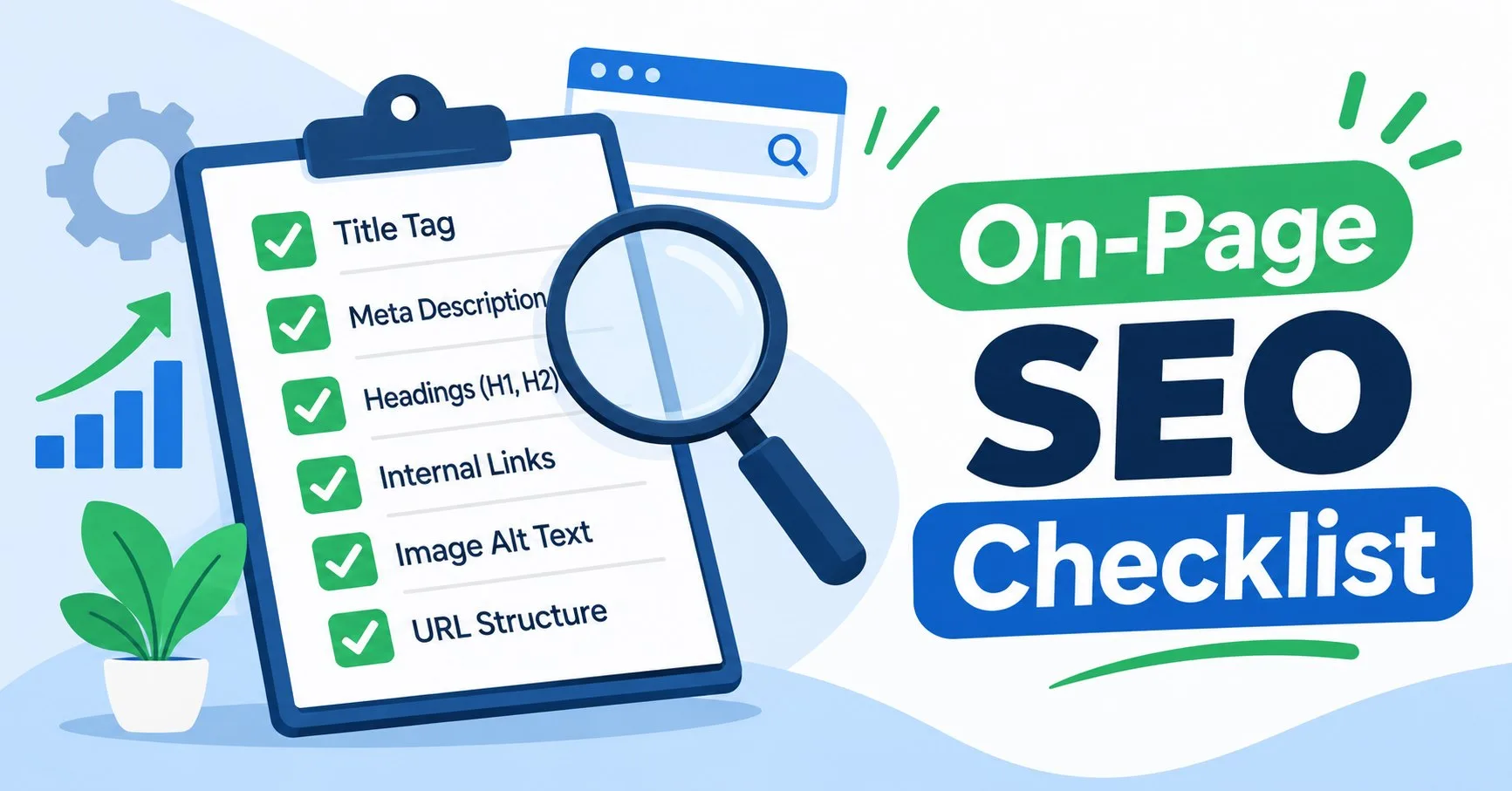
An on-page SEO checklist is your roadmap to creating web pages that Google and your audience both love. It’s a systematic process for optimizing the content and HTML of each page to improve its visibility and ranking in search results. Following a thorough checklist ensures you never miss a critical optimization step, leading to more organic traffic and better engagement. This guide provides a comprehensive, 25-step checklist that any business owner or marketer in Bangladesh can follow to get their pages ranking higher in 2026. Mastering these steps is a fundamental part of any successful strategy for SEO in Bangladesh.
Key Takeaways
- Match Intent: Before writing, understand if users want to learn, buy, or find something specific. Your content must match this search intent.
- Optimize Core Elements: Your page's title tag, meta description, and URL are the first things users and Google see. Make them clear, compelling, and keyword-focused.
- Content is King: Write comprehensive, easy-to-read content. Use headings, images, and lists to break up text and improve user experience.
- Build a Strong Structure: Use internal links to guide users and search engines through your site, and link out to other authoritative sources to build trust.
- Final QA is Crucial: Always perform a final quality assurance check before publishing to catch errors in titles, descriptions, images, and links.
On This Page
- Pre-Optimization: Setting the Foundation
- Core On-Page Elements: The Must-Haves
- Content Optimization: Depth and Quality
- Advanced On-Page Signals
- The Final On-Page SEO QA Checklist
- Frequently Asked Questions
- Next Steps
- Related Reading
- Sources
Pre-Optimization: Setting the Foundation
The first step in any on-page SEO checklist happens before you write a single word. Proper planning ensures your content is relevant, targeted, and has a clear purpose. Skipping this stage is like building a house without a blueprint—it’s likely to fail.
1. Define Your Primary Keyword
Every page should target one primary keyword. This is the main search term you want the page to rank for. Use a tool like Google Keyword Planner or Ahrefs to find a term with decent search volume and manageable competition. For example, a travel agency in Dhaka might target "Sundarban tour package from Dhaka" instead of the broader, more competitive term "tour package."
2. Analyze Search Intent
Search intent is the 'why' behind a search query. You must match your content to what the user wants. There are four main types:
- Informational: The user wants to learn something (e.g., "what is on-page SEO").
- Navigational: The user wants to find a specific website (e.g., "Abir Hasan Sabbir blog").
- Commercial: The user is researching before a purchase (e.g., "best SEO tools").
- Transactional: The user wants to buy something now (e.g., "buy n8n course").
Your content format must align with the dominant intent for your keyword. If all top results are "how-to" guides, a product page is unlikely to rank. Misaligning with intent is one of the most common reasons pages fail to gain traction, no matter how well-optimized they are otherwise.
3. Study the Top-Ranking Pages
Google the primary keyword and analyze the top 5-10 results. What kind of content is ranking? Are they blog posts, product pages, or videos? How long are they? What headings do they use? This analysis reveals what Google considers high-quality, relevant content for that query and gives you a template for success.
Core On-Page Elements: The Must-Haves
These are the foundational on-page factors that search engines use to understand and rank your page. Getting them right is non-negotiable for visibility in search results.
4. Craft a Compelling, Keyword-Rich Title Tag
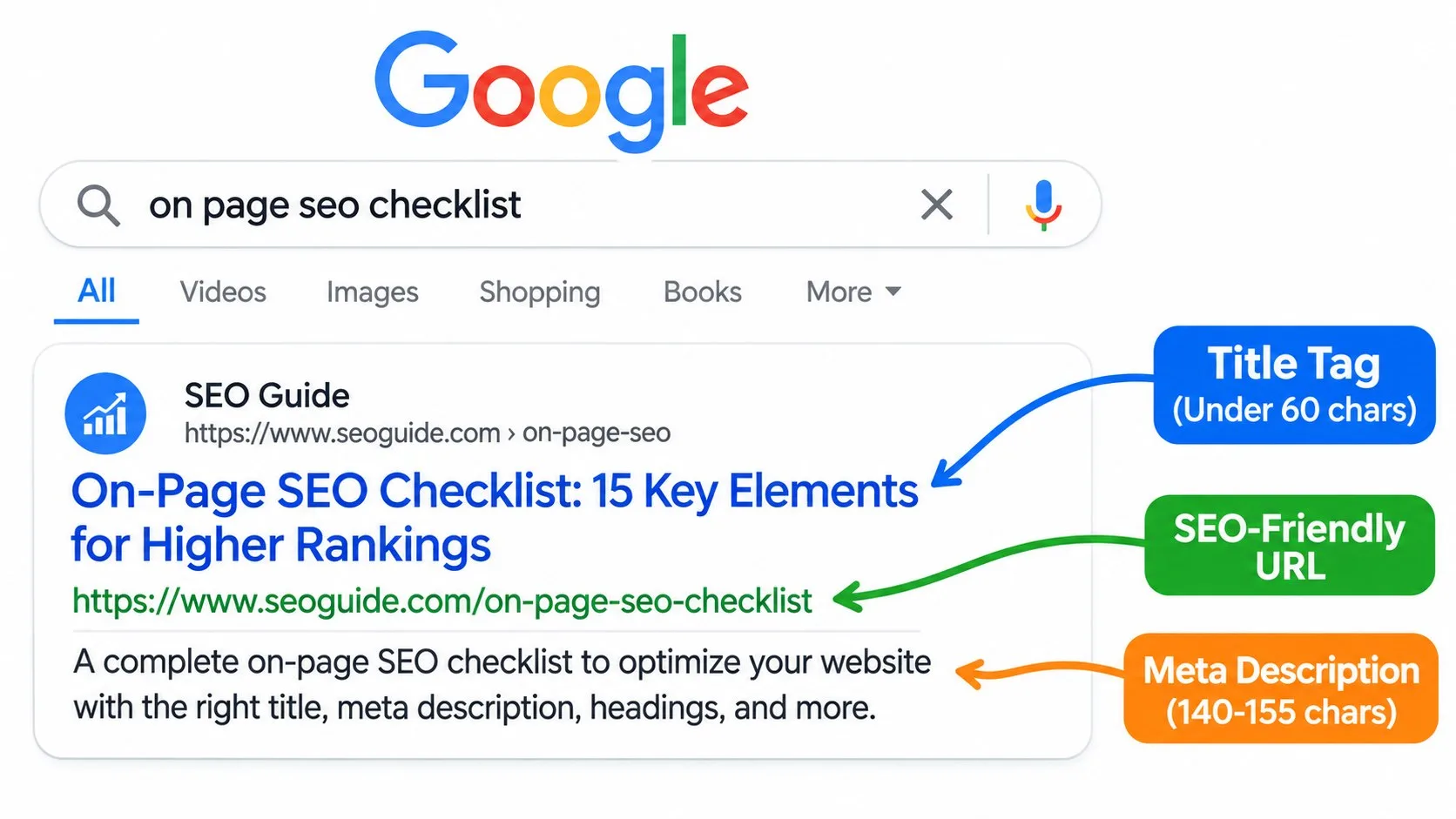
The title tag is the blue clickable link in search results. It's a major ranking factor. Your title should:
- Be under 60 characters to avoid being cut off.
- Include your primary keyword, preferably near the beginning.
- Be unique for every page on your site.
- Be compelling enough to make someone want to click.
Example: On-Page SEO Checklist (2026) vs. My New Blog Post
5. Write an Actionable Meta Description
The meta description is the short text snippet below the title in search results. While not a direct ranking factor, it heavily influences click-through rate (CTR). A good meta description:
- Is between 140-155 characters.
- Includes the primary keyword.
- Acts like an "ad" for your page, explaining the benefit and encouraging a click.
6. Create a Short, SEO-Friendly URL Slug
The URL should be simple, readable, and descriptive. A clean URL helps users and search engines understand the page's topic at a glance.
- Keep it short and concise.
- Include your primary keyword.
- Use hyphens (-) to separate words (e.g., /on-page-seo-checklist).
- Use all lowercase letters.
7. Use Your Primary Keyword in the First 100 Words
Placing your primary keyword early in your introductory paragraph confirms the page's topic to Google immediately. It signals that your content is relevant to the keyword you're targeting right from the start. Don't force it; make it feel natural within the opening sentences.
8. Structure Content with a Single H1 Tag
The H1 tag is your page's main headline. There should be only one H1 per page. It should be very similar to your title tag and clearly state the page's topic, including the primary keyword.
9. Use Header Tags (H2, H3) for Hierarchy and Readability
Header tags (H2, H3, H4, etc.) organize your content into logical sections. They make the article easier for users to scan and help search engines understand the structure and subtopics covered. Use your primary and secondary keywords in some of your H2s and H3s where it makes sense.
Content Optimization: Depth and Quality
The quality, depth, and presentation of your content are paramount. Google's algorithms are designed to reward pages that provide the most comprehensive and satisfying answer to a user's query.
10. Write Comprehensive, In-Depth Content
Your content should aim to be the best resource on the internet for your chosen topic. Cover the subject from all angles, answer related questions, and provide more value than your competitors. While word count isn't a direct ranking factor, top-ranking content is often longer because it is more thorough.
11. Incorporate Secondary and LSI Keywords Naturally
Secondary keywords are variations of your primary term (e.g., "on page seo optimization"). Latent Semantic Indexing (LSI) keywords are terms that are topically related (e.g., "search intent," "alt text," "schema"). Sprinkling these throughout your content helps Google understand the context and depth of your article.
12. Prioritize Readability and Formatting
No one wants to read a giant wall of text. Improve readability by using:
- Short sentences and paragraphs.
- Bulleted and numbered lists.
- Bold and italic text for emphasis.
- Blockquotes for definitions or key takeaways.
13. Optimize Images with Alt Text and Descriptive Filenames
Every image on your page offers an optimization opportunity. Before uploading, ensure the filename is descriptive (e.g., on-page-seo-checklist.jpg, not IMG_1234.jpg). After uploading, add descriptive alt text that explains what the image shows. This helps with accessibility and allows your images to rank in Google Images.
14. Add Relevant Outbound Links to Authoritative Sources
Linking out to respected, authoritative websites on a topic can increase the trustworthiness of your own content. It shows you've done your research and are providing well-supported information. Link to studies, statistics, or official resources where relevant.
15. Implement a Smart Internal Linking Strategy
Internal links are links from one page on your site to another. They help Google discover your content, spread link equity (ranking power) throughout your site, and keep users engaged longer. A well-planned internal linking approach is key to building a strong SEO silo strategy. For complex websites, a professional search engine optimization service can be invaluable in designing an effective linking architecture.
Advanced On-Page Signals
Once you've mastered the basics, these advanced techniques can give you a competitive edge and improve how your site is represented in search results.
16. Add Schema Markup for Rich Snippets
Schema markup is a code vocabulary you add to your site's HTML to help search engines understand your content more effectively. It can lead to "rich snippets" in search results, like star ratings, event details, or FAQ dropdowns, which can significantly boost your CTR.
17. Ensure Mobile-Friendliness
With Google's mobile-first indexing, your site's mobile version is the primary one for ranking. Your website must be responsive and provide a seamless experience on all devices. Use Google's Mobile-Friendly Test to check your pages.
18. Check Page Load Speed
Page speed is a confirmed ranking factor. A slow-loading page leads to poor user experience and higher bounce rates. Use tools like Google PageSpeed Insights to analyze your page speed and get recommendations for improvement, such as compressing images and leveraging browser caching.
19. Check for Keyword Cannibalization
Keyword cannibalization occurs when multiple pages on your website compete for the same primary keyword. This confuses search engines and dilutes your authority. If you find multiple pages targeting the same term, consider merging them into one comprehensive piece or re-optimizing one for a different keyword.
20. Use Original Images and Multimedia
Stock photos are fine, but original images, infographics, and videos make your content unique and more engaging. Custom graphics that explain a concept or data can be highly shareable and attract backlinks, further boosting your SEO.
The Final On-Page SEO QA Checklist
Before you hit "publish," run through this final quality assurance (QA) checklist. This five-minute review can catch costly mistakes and ensure every piece of content you ship is perfectly optimized.
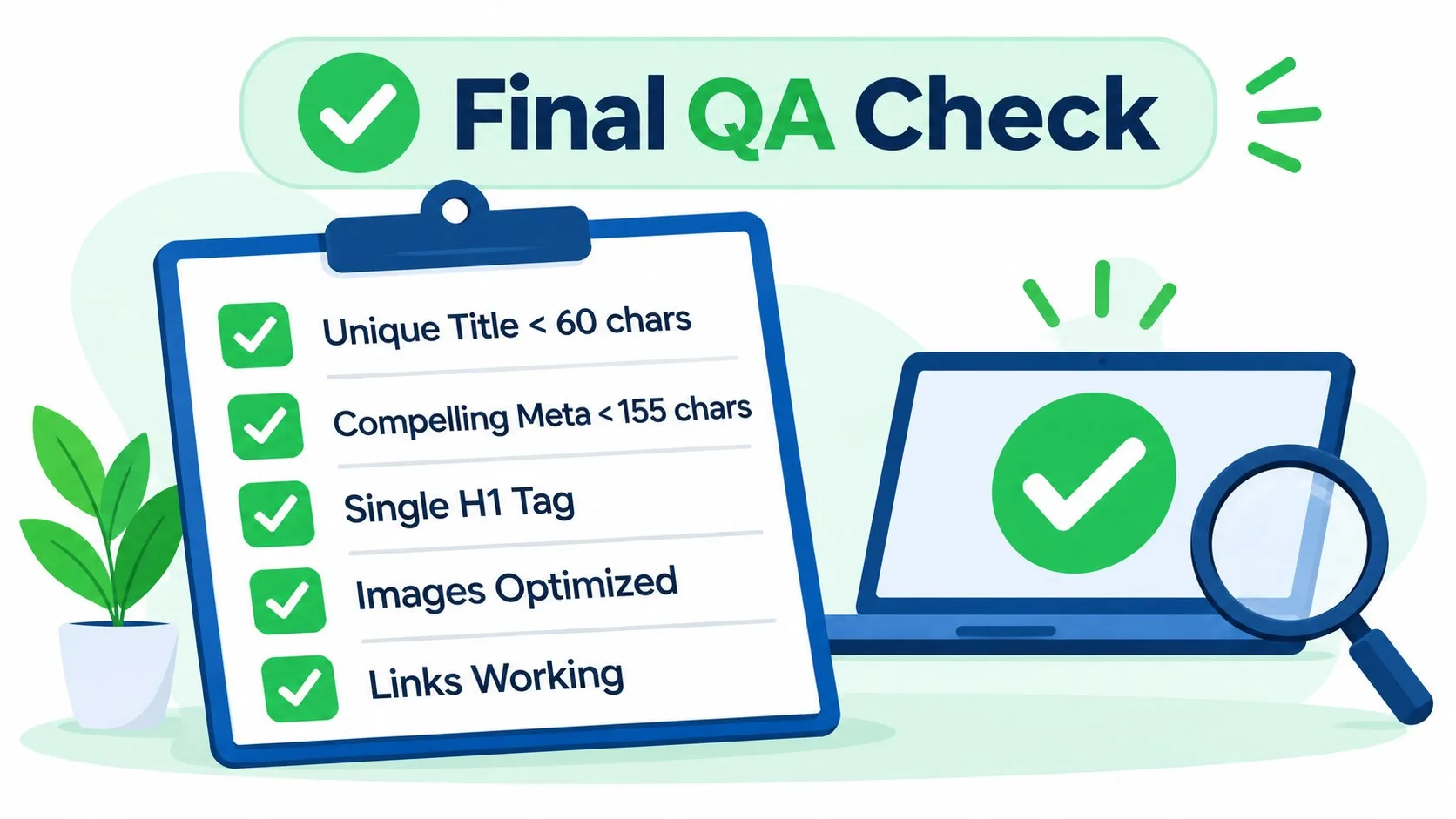
21. Is the title tag under 60 characters and unique?
Verify that your title is concise, includes the keyword, and doesn't duplicate any other title on your site.
22. Is the meta description under 155 characters and compelling?
Check for length and ensure it accurately describes the page content while encouraging a click.
23. Does the page have one, and only one, H1 tag?
Use a browser extension like "SEO META in 1 CLICK" to quickly verify your heading structure. Ensure there's a single, clear H1.
24. Are all images compressed and have alt text?
Double-check that every image has descriptive alt text and has been compressed to ensure fast page load times.
25. Are internal and external links working and relevant?
Click every link on the page to ensure they are not broken and that they open in a new tab (for external links) to keep users on your site.
Frequently Asked Questions
What is the most important on-page SEO factor?
While all factors are important, the most critical is creating high-quality, comprehensive content that perfectly matches the user's search intent. Without great content, optimizations to titles, metas, and other elements will have little impact. Content is the foundation upon which all other on-page SEO is built.
How often should I perform on-page SEO?
On-page SEO is not a one-time task. You should perform a full on-page audit for every new piece of content you publish. Additionally, it's good practice to review and refresh your most important existing pages every 6-12 months to keep them up-to-date and aligned with current best practices.
Can I do on-page SEO myself?
Absolutely. On-page SEO is one of the most accessible parts of search engine optimization. By following a detailed checklist like this one, anyone can learn to optimize their own pages. It requires attention to detail and a commitment to creating quality content, but the tools and principles are straightforward.
What is the difference between on-page and off-page SEO?
On-page SEO refers to all optimizations you control directly on your website, like content, title tags, and images. Off-page SEO refers to actions taken outside of your website to improve its authority and ranking, primarily through building high-quality backlinks from other reputable sites.
How long does it take to see results from on-page SEO?
Results are not instant. After implementing on-page SEO changes, it can take anywhere from a few weeks to several months for Google to re-crawl your pages and adjust rankings. The timeline depends on your site's authority, the competitiveness of the keyword, and the quality of your changes.
Is keyword stuffing bad for SEO?
Yes, keyword stuffing—the practice of unnaturally loading a page with keywords—is a black-hat SEO tactic that is penalized by Google. Keywords should be used naturally and contextually. Focus on creating a good user experience, not on hitting an arbitrary keyword density percentage.
Does every page need a unique title and meta description?
Yes, it is critical. Duplicate title tags and meta descriptions are a common SEO issue that can confuse search engines and dilute your ranking potential. Every single page on your website should have a unique, descriptive title and meta description tailored to its specific content.
What is a good page speed for SEO?
You should aim for your page to load in under 3 seconds. Google's PageSpeed Insights will give you a score out of 100 for both mobile and desktop. While a perfect score is not necessary, aiming for a score in the "Good" range (90-100) is a strong goal for providing excellent user experience.
Next Steps
Now that you have the complete on-page SEO checklist, it's time to put it into action.
- Audit an Existing Page: Pick one of your important but underperforming pages and run it through this 25-step checklist.
- Implement the Changes: Systematically apply the optimizations, starting from the core elements and moving to content and advanced signals.
- Use This for All New Content: Make this checklist a standard part of your content creation process to ensure every new page is built for ranking success from day one.
If you're looking for a dedicated partner to implement these strategies and drive organic growth, consider our professional SEO service in Bangladesh.
Related Reading
- SEO in Bangladesh: How to Rank Your Website on Google in 2026
- SEO Silo Strategy: How to Build One in 2026 (Step-by-Step)
Sources
- On-page SEO checklist: The complete task list for 2026
- SEO Best Practices - On Page SEO Checklist
- The Complete SEO Checklist
Checked on 2026-11-05.