Is your business drowning in manual tasks? You’ve heard that AI can help, but the terminology is confusing. Every software now claims to have an "AI agent," while others talk about "workflow automation." It's easy to get lost and wonder what your business actually needs. Are they the same thing? And which one will actually save you time and money?
The short answer is: they are fundamentally different. Workflow automation follows predefined rules you set, while an AI agent can think and make its own decisions to achieve a goal. For most small and medium-sized businesses in Bangladesh, starting with robust workflow automation provides the fastest and most reliable return on investment, while true AI agents are a powerful tool for specific, complex problems later on.
Key Takeaways
- Workflow Automation: Best for repetitive, predictable tasks with clear rules (e.g., saving Facebook leads to Google Sheets). It's reliable, low-cost, and offers immediate ROI.
- AI Agents: Best for complex, unpredictable tasks that require reasoning and real-time decisions (e.g., analyzing market data to find new opportunities). They are more expensive and carry higher risks.
- The Verdict for Most Businesses: Start by automating your structured processes first. Build a solid foundation of efficiency, then explore AI agents for high-value, specific challenges.
- The Hybrid Approach: The most practical solution is often a hybrid: using an AI agent as one intelligent step inside a larger, predictable automated workflow.
On This Page
- The Core Difference: Who Makes the Decisions?
- AI Agent vs. Automation: A Side-by-Side Comparison
- Use Cases for a Small Business in Bangladesh
- The Hybrid Approach: Combining Automation and AI Agents with n8n
- Cost and Risk: A Realistic Look
- Frequently Asked Questions
- Next Steps for Your Business
- Related Reading
- Sources
The Core Difference: Who Makes the Decisions?
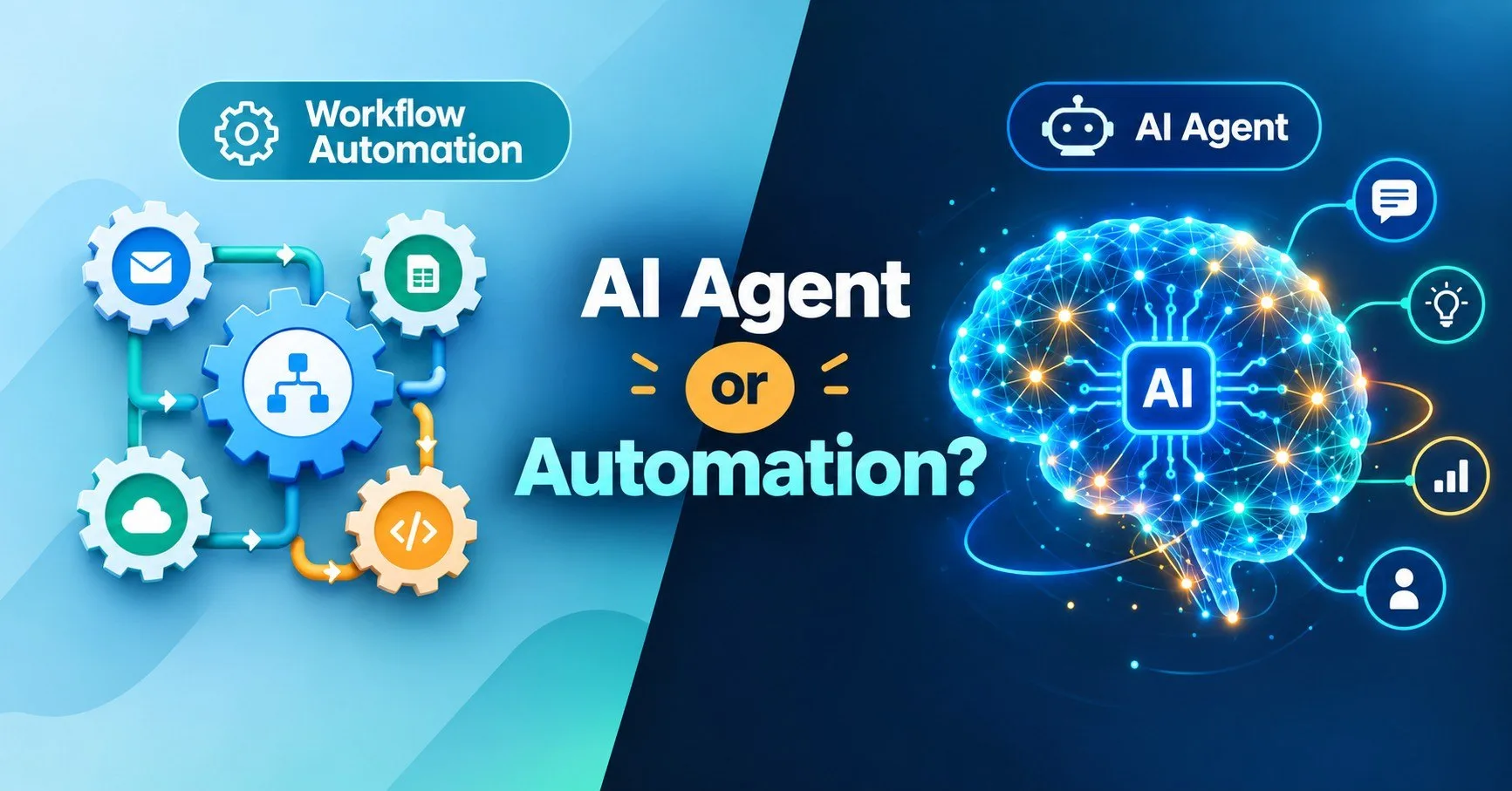
The fundamental difference between an AI agent and workflow automation lies in who makes the decisions: automation follows a pre-programmed script you create, while an AI agent autonomously decides its own next steps to achieve a goal.
What is Workflow Automation? (The Reliable Rule-Follower)
Think of workflow automation as a digital assembly line. It connects your apps and services (like Facebook, Google Sheets, and WhatsApp) and performs a sequence of actions based on strict "if this, then that" logic. You design the entire process from start to finish.
The path is fixed. For example:
IF a new lead comes from a Facebook Ad, THEN save their name and phone number to a Google Sheet, AND THEN send a confirmation message via WhatsApp.
This process will run the exact same way every single time. It's predictable, highly reliable, and incredibly efficient for repetitive tasks. Tools like n8n, Zapier, and Make are the engines behind this type of automation.
What is an AI Agent? (The Autonomous Problem-Solver)
An AI agent, often called "agentic AI," operates on a completely different principle. Instead of giving it a step-by-step plan, you give it a goal, access to tools (like web search or your company's database), and the ability to reason using a Large Language Model (LLM) like Google's Gemini.
It's less like an assembly line and more like a junior assistant. You don't tell the assistant *how* to do the task, you just tell them *what* you want to achieve.
For example, you could give an agent this goal: "Summarize all customer feedback from our Facebook page this week and identify the top 3 complaints." The agent would then devise its own plan: access the page, read all comments and messages, analyze the sentiment of each, group similar complaints, and compile a summary report.
Be aware of "agent washing"—a trend where companies rebrand simple automation as "AI agents." A true agent must have the ability to make its own choices.
AI Agent vs. Automation: A Side-by-Side Comparison
Choosing between them depends on your task's complexity, predictability, and cost, with automation excelling at structured processes and agents at dynamic ones. This table breaks down the key distinctions.
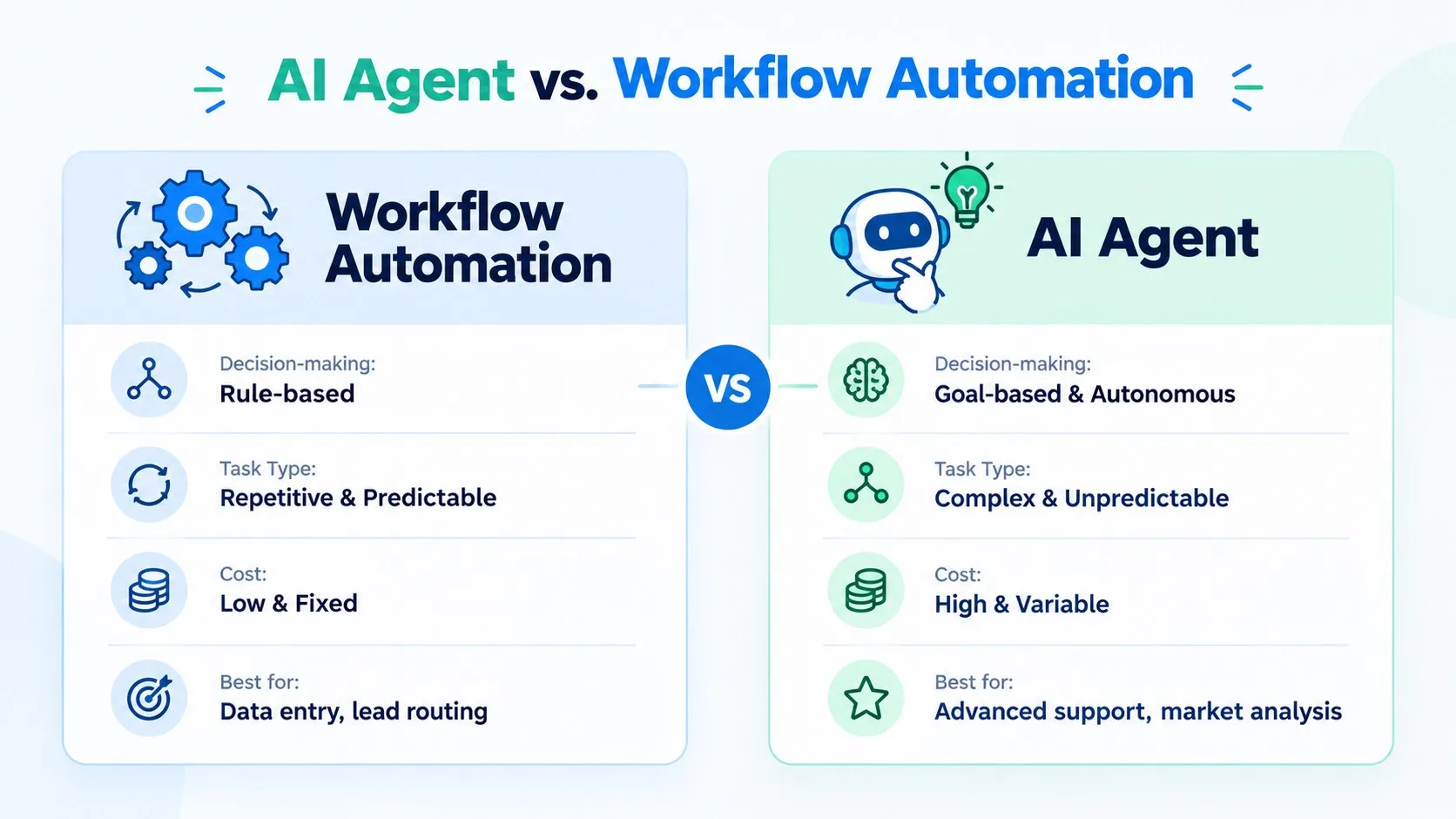
| Feature | Workflow Automation | AI Agent |
|---|---|---|
| Decision Making | Rule-based, follows a predefined path. | Goal-based, decides its own path. |
| Flexibility | Low. Changes require manually editing the workflow. | High. Adapts to new information in real-time. |
| Task Type | Repetitive, predictable, structured. | Complex, unpredictable, open-ended. |
| Setup Complexity | Low to Medium. Visual builders are very accessible. | High. Requires expertise in LLMs, APIs, and prompt engineering. |
| Cost | Lower. Predictable pricing (per task or monthly). | Higher. Involves LLM API costs (per token) plus development. |
| Risk | Low. Predictable behavior, easy to debug. | Higher. "Hallucinations" or incorrect actions are possible. |
| Best for... | Lead management, data entry, social media posting. | Advanced customer service, market research, proactive analysis. |
Use Cases for a Small Business in Bangladesh
For most Bangladeshi small businesses, workflow automation offers immediate wins in marketing and operations, while AI agents are better suited for specialized tasks like advanced customer interaction.
When to Choose Workflow Automation (Your First 90 Days of Efficiency)
Focus on automating tasks that are high-volume, repetitive, and rule-based. These are your quickest wins.
- F-commerce & Lead Management: When a customer places an order via a Facebook comment or a lead ad, automatically capture their details, save them to a Google Sheet, and send an instant confirmation on WhatsApp or Messenger. This ensures no lead is ever lost. For more ideas, see this guide on what to automate first.
- Content Marketing: As a Digital Marketing Executive, I automate content distribution. When a new blog post is published for Naria Travels and Tours, a workflow automatically shares it on our Facebook page and schedules several follow-up posts over the next month with different captions.
- E-commerce Onboarding: For my project be Skillify, when someone purchases a digital marketing template from our WooCommerce store, an automation instantly sends them the download link, adds them to a customer-only email list, and sends them an invitation to our support group.
When to Consider an AI Agent (Your Advanced Growth Engine)
Consider an agent when the task requires understanding, judgment, or synthesis of unpredictable information.
- Intelligent Customer Support: Imagine a customer asks your Telegram support bot: "I want a 3-day tour of Sylhet for 2 people next month, my budget is BDT 15,000. I need a hotel with good reviews." A simple chatbot would fail. An AI agent could check your tour database, filter by location and price, check hotel review scores via an API, and construct a personalized recommendation. You can build the foundation for this with an n8n Telegram bot.
- Proactive Competitor Analysis: You could task an agent with the goal: "Monitor the top 5 travel agencies in Dhaka and report any new tour packages for Cox's Bazar." The agent would periodically check their websites and social media, identify new offers, extract the price and itinerary, and send you a weekly digest.
- Dynamic Social Media Engagement: An agent could monitor your brand mentions and classify them by sentiment. If it detects a highly negative and urgent complaint, it could autonomously create a high-priority ticket in your support system with a summary of the issue.
The Hybrid Approach: Combining Automation and AI Agents with n8n
The most powerful and practical solution is often a hybrid model where a structured workflow calls an AI agent to handle a single, complex step, giving you the best of both worlds. This is where a tool like n8n truly shines, as you can build an `n8n ai agent` right inside your workflow.
Here’s a real-world example:
- Trigger (Automation): A customer leaves a 1-star review on your Facebook page.
- Workflow Step (Automation): The n8n workflow is triggered, capturing the review text and the customer's name.
- Agentic Step (AI): The workflow sends the review to an AI node (using Gemini or OpenAI) with a detailed prompt:
"You are a helpful customer service assistant. Analyze this negative review: '{review_text}'. First, summarize the core problem in one sentence. Second, draft a polite and empathetic public reply to {customer_name} that acknowledges their frustration and tells them you are looking into it and will contact them privately. Do not make any promises." - Workflow Step (Automation): The workflow takes the AI-generated draft reply and posts it as a comment in a private Slack channel for a human manager to review. With one click, the manager can approve it to be posted publicly. Simultaneously, the workflow creates a ticket in the company's CRM for follow-up.
In this model, you get the reliability of automation with a smart, "thinking" step, all supervised by a human.
Cost and Risk: A Realistic Look
Workflow automation typically has a predictable, lower monthly cost and minimal risk, whereas AI agents introduce variable costs based on usage and carry the risk of unpredictable behavior that requires human oversight.
The Cost of Automation
The costs here are straightforward. Platforms like Zapier have monthly plans often starting around $20-$50 USD. For businesses in Bangladesh, a far more cost-effective and powerful option is n8n. You can use their cloud plans or self-host it on a Virtual Private Server (VPS) for as little as ৳500-৳1,000 per month, giving you nearly unlimited automation power for a fixed price.
The Cost and Risk of AI Agents
Here, the picture is more complex.
- API Costs: You pay the AI provider (like Google or OpenAI) for every request. This is based on "tokens," which are pieces of words. Complex tasks that require a lot of reading and writing can become expensive, and costs can be unpredictable.
- Development Costs: Building a reliable agent is significantly more complex than a workflow. It requires specialized skills.
- Business Risk: According to industry analysts, a significant number of agentic AI projects are canceled due to unclear ROI. There's also the risk of "hallucinations," where the AI makes up facts or takes incorrect actions. An agent mistakenly offering a 50% discount to every customer could be disastrous. This is why the hybrid, human-in-the-loop approach is so critical.
Frequently Asked Questions
What is the simplest way to explain the difference between an AI agent and automation?
Workflow automation follows a fixed set of rules you define, like an assembly line (If X happens, do Y). An AI agent is given a goal and can decide its own steps to achieve it, like an assistant who can think for themselves. The key difference is autonomous decision-making.
Is a chatbot an AI agent?
Not usually. Most chatbots are a form of workflow automation. They follow a predefined script or decision tree. However, a very advanced chatbot that can understand complex, open-ended queries, access tools, and reason about the best answer could be considered a simple AI agent.
What are the risks of using AI agents for a small business?
The main risks are higher, unpredictable costs from API usage and the potential for "hallucinations" or errors where the agent makes a bad decision. This can harm customer trust or business operations. They require careful setup and human oversight, unlike more predictable rule-based automation.
Can I build an AI agent myself?
Building a true AI agent is complex and typically requires strong programming and prompt engineering skills. However, you can build simpler "agentic" systems using tools like n8n combined with LLMs like Gemini. This allows you to add a "thinking" step to an otherwise standard workflow.
How much does workflow automation cost for a small business in Bangladesh?
Costs vary. SaaS platforms like Zapier might cost ৳2,000-৳5,000 per month. A more affordable option is self-hosting a tool like n8n on a VPS, which can cost as little as ৳500-৳1,000 per month for the server, giving you immense power for a low, fixed price.
What is an example of an n8n AI agent?
An "n8n AI agent" usually refers to a hybrid workflow. For example, a workflow is triggered by a new customer email. It then uses an AI node (like the Gemini node) to analyze the email's sentiment and content, decide if it's urgent, and then route it to the correct person. The AI makes a decision within the automated process.
Which is better for lead generation, an AI agent or automation?
For 99% of small businesses, workflow automation is far better for lead generation. You need a reliable, rule-based system to capture leads from forms (like Facebook Lead Ads), save them to a sheet, and send instant follow-ups. An AI agent is overkill and too expensive for this core task.
What is "agent washing"?
"Agent washing" is a marketing term for when companies rebrand their existing automation tools or simple AI features as powerful "AI agents" to seem more advanced. Many so-called agents are just rule-based workflows with a new label, so it's important to look closely at their actual capabilities.
Next Steps for Your Business
Navigating the choice between AI agents and workflow automation doesn't have to be complicated. It’s about choosing the right tool for the right job at the right time. For most businesses, the path is clear: start with automation to build an efficient, reliable foundation before exploring the advanced capabilities of AI agents.
- Audit Your Processes: Spend a day identifying every repetitive, manual task you or your team does. Check our list of business automation ideas for inspiration.
- Start with One Simple Workflow: Don't try to automate everything at once. Pick one high-impact task, like capturing leads from your Facebook page, and build your first workflow with a tool like n8n.
- Measure the ROI: Track the hours you save. Seeing that number grow from 2 hours a week to 10 hours a week is the best motivation to continue.
- Identify One "Thinking" Problem: Once your automations are running smoothly, find one task that requires judgment, like analyzing customer feedback or answering complex questions. This is your candidate for a hybrid AI workflow.
Ready to stop wasting time on manual tasks and find out if workflow automation or an AI agent is right for you? Book a free consultation call, and let's design a custom automation strategy for your business.
Related Reading
- n8n Telegram Bot Tutorial: Build an AI Assistant with Gemini
- Business Automation Ideas: 10 Things to Automate First (and 5 to Never Automate)
Sources
- AI Agents vs. Automation: Understand the Difference & ...
- AI Agents vs Automation in Sales: How to Tell the Difference
- AI agents vs traditional automation - why starting simple ...
Checked on 2026-10-25.