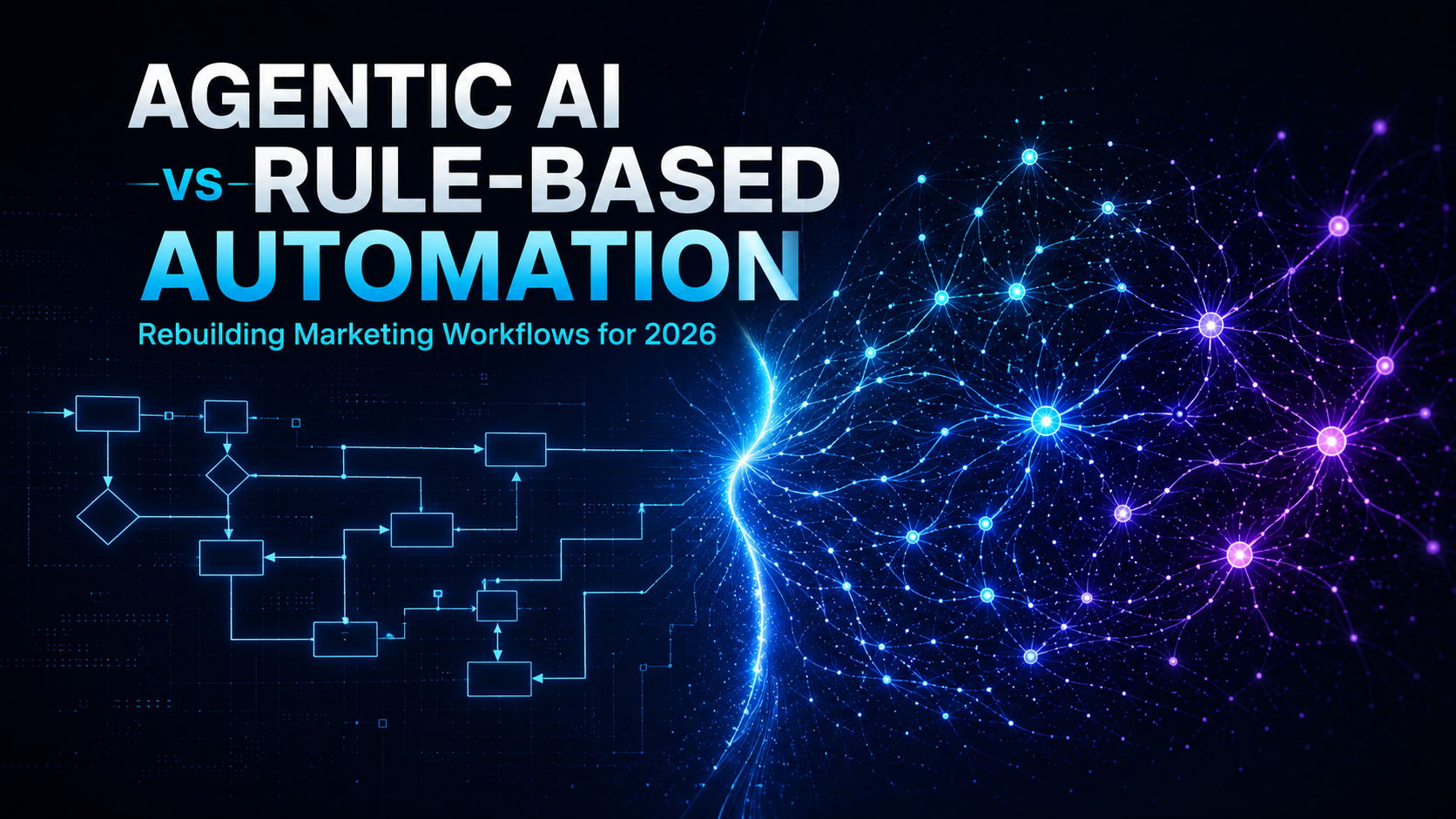
For the last three years, "marketing automation" mostly meant one thing: trigger → condition → action. If a lead filled a form, send an email. If a post underperformed, flag it. This is the world Zapier, Make, and early n8n workflows were built for — deterministic, linear, and safe.
That world is ending.
What's replacing it isn't a bigger if/else tree — it's agentic systems: AI components inside your workflow that can reason, choose between multiple valid paths, call other tools, and correct their own output before a human ever sees it. Having built both types — rule-based news pipelines and multi-agent content systems — I want to break down what actually changes when you move from one to the other, and why most "AI automation" being sold right now is still just automation with an AI-generated caption bolted on.
1. The Core Difference: Branches vs. Decisions
A rule-based workflow branches on data you already know the shape of.
IF engagement_rate < 2% → send to "underperforming" Slack channel
IF category = "SEO" → apply SEO taxonomy tags
An agentic workflow makes a decision on data whose shape it has to interpret first. Instead of a fixed IF node, you hand the agent a goal and a toolbox:
Goal: "Classify this article, choose the correct taxonomy IDs from the
live taxonomy table, and flag anything that risks keyword cannibalization
with our last 10 published posts."

Tools available: query_taxonomy_table(), search_recent_posts(),
flag_for_review()
The agent decides which tool to call, in what order, and whether to call itself again if the first attempt looks wrong. This is the single biggest architectural shift: your workflow stops being a flowchart and starts being a loop with judgment.
2. Where This Actually Breaks (and Nobody Talks About It)
Every "AI agent" tutorial shows the happy path. In production, three failure modes show up constantly:
a) Taxonomy and ID mismatches. The moment you let an agent choose category/tag IDs dynamically instead of hardcoding them, you introduce a class of bug that's invisible in testing and expensive in production — an agent confidently assigns a tag ID from the wrong table because two schemas share a similar shape. The fix isn't "better prompting." It's structural: split the taxonomy-resolution step into its own single-purpose agent with a locked schema reference, instead of asking one general agent to "handle content and categorize it." Narrow the agent's job until it can't misinterpret the table it's querying.
b) Approval fatigue. Once an agent can publish autonomously, teams overcorrect and put a human approval gate on everything — which kills the entire point of automation. The better pattern is a confidence-tiered gate: high-confidence, low-risk actions (drafting, tagging, image sourcing) run autonomously; only irreversible or brand-risk actions (publishing live, sending to a real customer list) route to a human via Slack/Telegram approval. This is the difference between an automation that saves you two hours a day and one that just moves your busywork into an approval queue.
c) Silent drift. Rule-based systems fail loudly — a broken API returns an error and the workflow stops. Agentic systems fail quietly — the agent still produces an output, it's just subtly wrong (a caption that's off-brand, a category that's technically valid but strategically bad). You need explicit evaluation checkpoints, not just error handling. Log every agent decision with its reasoning, and review a sample weekly — not because it crashed, but because it might have been confidently wrong.
3. A Practical Reference Architecture
Here's the shape of a production content pipeline that actually holds up, built around five layers instead of one big prompt:
LayerJobExample ToolIngestionPull structured input (keywords, RSS, form data)Google Sheets / Gmail triggerGeneration AgentDraft content against a locked style guideGPT-4o with a scoped system promptClassification AgentResolve taxonomy, tags, internal linksNarrow, single-purpose agent + DB query toolEnrichmentNon-AI, deterministic stepsPexels/DALL-E image fetch, schema markup injectionGate + PublishConfidence-based routingSlack/Telegram approval → CMS API
Notice that only two of five layers involve an LLM at all. This is the part most people get backwards — they try to make everything agentic, when the highest-ROI move is usually isolating the 20% of the workflow that genuinely needs judgment and keeping the rest boringly deterministic. Deterministic steps don't hallucinate, don't cost tokens, and don't need evaluation.
4. What This Means for Marketing Teams Specifically
If you run marketing for a brand — not a dev team — here's the practical takeaway: stop asking "can AI write this for us?" That question was answered two years ago. The real question for 2026 is:
"Which decisions in our content and campaign process require judgment, and which just require consistency?"
Consistency (formatting, tagging, scheduling, basic personalization) should be fully deterministic — it's cheaper, faster, and doesn't need a human in the loop. Judgment (positioning, brand voice edge cases, cannibalization risk, campaign budget allocation under real constraints) is where an agent — with a tight, well-scoped job — adds real value, provided you build the confidence gate around it instead of trusting it blindly.
Teams that skip this distinction end up with one of two failure states: either an over-engineered agent system babysitting tasks a simple IF-node could handle, or a fully "autonomous" pipeline publishing errors at scale because nobody built the approval tier. The winning setups I've seen — and built — sit deliberately in between.
Closing Thought
Agentic AI isn't a bigger automation. It's a different discipline — closer to managing a very fast, very literal junior employee than programming a flowchart. The teams getting real ROI from it in 2026 aren't the ones with the most AI in their pipeline. They're the ones who figured out exactly where judgment is worth the risk, and automated everything else into boredom.